Sunday, June 2, 2013

Cheese Factories, Limestone Cities, Stars, Language, and Provinces


Cheese Factories, Limestone Cities, Stars, Language, and Provinces

Midway through the main trek, we are going from the town of Quilotoa to Chucchilán, where we will trek through the cloudforest. Near there is a local cheese factory, which we have the option of visiting. The cheese factories (queserías) started in Salinas, where in 1971 Italian missionary Antonio Polo thought of setting up the factories as a solution to poverty there. Later on, the cooperative opened up about 20 more factories around the area and in other provinces as well.

In 1756, a smallpox epidemic prompted the government in Quito to order all buildings in the city to be painted with white limestone, which people believed to be a disinfectant. They stayed that way until the 1980s, when the people decided to repaint the buildings. Art historians did research on the proper former colors of the city, and by now most of the city’s Old Town has been returned to its pre-epidemic palette.

other random facts:
The constellation Orion can be seen in both hemispheres. Many of the zodiac constellations are visible from the southern hemisphere. The north star cannot be seen from anywhere in the Southern Hemisphere and there is no equivalent star.

Knowing some phrases in Quicha (not just Spanish) will be helpful at the villages of our main trek. So far I have yet to find much useful information about the language besides http://en.wikipedia.org/wiki/Kichwa_language

These are the provinces we will mainly be visiting: Quito is the capital of Pichincha. Tena and the community we are visiting, Puma Rumi, are located in Napo (Tena is the capital), and the Laguna Quilotoa is located in Cotopaxi province, the capital of which is Latacunga.

-Marielle


Sunday, May 12, 2013


So not all these facts will be weird or unknown, but hopefully they're all interesting!

  • The Ecuadorian national sport is soccer (or futbol) so obviously they have great taste in sports 
  • Other popular sports include bullfighting and volleyball (although that is played with a soccer ball) 
  • For foods, Ecuador is the world's highest banana exporter! 
  • Don't eat with your hands there, it is considered very rude! (including pizza) 
  • Ecuadorians consider guinea pig to be a delicacy so if you have one for a pet try not to be offended...
  • (He's so cute!) 
  • Ecuador's national music is pasillo (according to youtube this is an example of that: http://www.youtube.com/watch?v=u9nz7yLcpBI)
  • The Ecuadorian flag's colors are yellow for the diversity of the country, blue for the sea and sky, and red for the blood of those who fought for independence 
  • Ecuador was the first nation in 2008 to declare that nature has constitutional rights (equality for everything!) 
  • My last fact is going to be that Ecuador has the world's highest diversity of humming bird species 
  • I'll leave you with one last picture: 
  • (They're just too cute to eat!!) 
-Haley 

Sunday, May 5, 2013

The Spanish Language

DISCLAIMER: I have not studied Spanish (in depth) in a number of years so in no way shape or form am I claiming to be all knowing about this topic. The information collected is an amalgamation from Spanish dictionaries, Google translate and the help of my younger sister. 

So a great majority of the people in Ecuador speak Spanish, and one of the most important things to know how to say are questions such as where is the bathroom? Because why, on earth would you choose to go the bathroom in the woods when there was a restroom nearby? Unless you like practice going the bathroom in the woods, or if the bathrooms smelled really really bad, there is no good reason. Below are some questions that are good to know:

Where is the bathroom?                  ¿Dónde está el baño
How much is this?                           ¿Cuánto cuesta esto?
Do you speak English?                    ¿habla usted Inglés
Do you have change for...?             ¿tiene cambio para ...?
Can I eat this? 
What time is it?                              ¿qué hora es?
Where am I?                                 ¿Dónde estoy?
Cuando...                                      ¿When
What is your name?                       ¿Como te llama?

 The word llama reminds me of llama (hmm I wonder why) so please enjoy this picture of a Chilean llama.

  
 In addition to asking questions, there are other words that may be helpful to know such as one of the basic necessities for human life to function, water.

Water                                   Agua
Food                                    Comida
Bathroom                              El bano
Please                                   Por favor (to be used at the end of sentences)
Thanks                                  Gracis
Man                                      Hombre88.
Woman                                 Mujer 
We, us                                  Nosotros
Boy, girl                                Chico, chica
Usted                                    You
Help me                                Ayudame (used if you happen to be in trouble) 
Thing                                     Cosa
Bad                                       Malo, mal
To understand                        Entender
To find                                   Encontra
I want                                    Quiero (said at a market, or when in a restaurant)
Nice to meet you                    Mucho gusto (said when greeting someone) 


Numbers will also prove themselves useful and hopefully everyone knows how to count to at least ten. Here is a list of numbers that might be needed:
20                          veinte
25                          veinticinco
30                          treinta          
40                          cuarenta
50                          cincuenta             
100                        cien 

Keep in mind that after 30, you say the number in the tens place, add "y" and then the number in the ones place. Well, to wrap it up, I hope this post helped those that didn't know much Spanish (such as myself) and hopefully even if you know Spanish well you still learned something.

Keep it crispy


~Nikisha

Monday, April 29, 2013


Quito is the capital city of Ecuador. It has an elevation of 9,350 feet as opposed to Franklin’s elevation of  300 feet. It has a population of about 2,197, 698 people. Quito has a fairly constant cool climate due to its high altitude. The closets volcano to Quito is Pichincha. 
This volcano last erupted in 1999 with only a few puffs of smoke and a large amount of ash. Its last major eruption was in 166o when more than 10in of ash coated the city.

In Quito, public transport it the primary source of transportation. It has a public bus transportation called the metro bus. 
It has taxi cabs as well as a shared bicycle system called the Bici. 

Some interesting points of interest are the Basilica del voto nacional, which is a huge gothic building, and the church of la compania de jesus. 
 

~Nicole


Sunday, April 7, 2013

Social Customs

When meeting people...
  • The most common greeting is a handshake with direct eye contact and a smile.
  • While shaking hands, use the appropriate greeting for the time of day: "buenos dias"(good morning), "buenas tardes" (good afternoon), or "buenas noches" (good evening).
  • Always refer to people by the appropriate honorific title (Senor or Senora) and their surname.

  • When eating breakfast/lunch/dinner...
    able manners are Continental -- the fork is held in the left hand and the knife in the right while eating.
  • Guests are served first.
  • The host says "buen provecho" ("enjoy" or "have a good meal") as an invitation to start eating.
  • Food is always eaten with utensils. Even fruit is eaten with a knife and fork.
  • it is considered good manners to help the guest prepare the table
  • they like table conversations! so try and be talkative or else it might offend the host
  • Ecuadorians don’t consider it polite to leave food on your plate after the meal. If you don’t finish your meal completely, they will think you didn’t like the meal or that it didn’t taste good.
  • don’t forget to thank your hosts. It is advisable to say the dinner was delicious, even if you didn’t like it much, or that you really enjoyed their company

  • Other random customs
  • “No Hay”: a “jazz hands” wave with the right hand isn’t a hello – it means “no hay,” – there isn’t any – whether that’s another seat on the bus, food in the kitchen or chips in the corner store.
  • most taxi drivers will try and charge more for a foreigner so try and bargain before you take off.  The minium fare is usually one dollar, no matter what the meter says and it costs more at night

  • Sunday, March 17, 2013

    Awesome Animals of the Galapagos

    Okay, first of all most of the animals we will see while we are visiting the Galapagos are found no where else on earth! Eighty percent of the land birds, and ninety seven percent of the mammals and reptiles are found no where else. That's super cool. So lets get this party started, shall we?

    As I am sure most of us know, the Galapagos is famous for its birds. Darwin and his research on the Finches ringing a bell? The finches are the most abundant species of birds on the islands.


    (greglasley.net) A warbler Finch

    There is a total of twenty nine species of land birds on the islands. The islands even have their own species of owls and hawk, called the Galapagos Hawk, Galapagos Short-Eared Owl and the Galapagos Barn Owl. The Hawks hunt during the day for insects, small lizards and rodents. The Galapagos Short Eared Owl hunts at night on island the Hawks inhabit and hunt during the day on islands where the Hawks do not live. They usually hunt the chicks of sea birds. The Barn owl hunts at night, and eats mostly insects and rodents.


    (Seancrane.net) Galapagos Hawk


    (galapagoscruises.com) Galapagos Barn Owl


    (Flickr.com) Galapagos Short-Eared Owl

    Along with the Land birds, there is also an extensive amount of Sea birds. There are fifty six native species of birds on the islands. The one I think is the most exciting? The Galapagos Penguin! Yes there are penguins, I am not making that up. They are one of the smaller species of Penguin, and are the only known species that lives close to and on the equator. They populate the western islands mostly, as the water is a little bit colder. They are also listed as an endangered species. Look at it, isn't it adorable?!


    (True-wildlife.blogspot.com) 

    So enough with the birds and onto iguanas! There are three species of land Iguanas on the islands, the Conolophus subcristatus, Conolophus pallidus and Conolophus marthae. All of the land Iguanas are large; they stretch longer than three feet and adult males can weigh up to thirty pounds. They live on the drier sections of the islands and can be found sunning themselves in the morning sun. The Iguana's eat plants and shrubs as well as fruit and cactus pads. 


    (naturephoto-cz.com) A land Iguana

    As well as Land Iguanas, there are also species of Marine Iguanas. Almost every shoreline is home to the Marine Iguana Amblyrhynchus cristatus. This is the only species of Marine Iguana on earth. They live on land but feed in the ocean on a variety of algae and seaweed. Fun fact: when they go hungry they do not only become thin but they also become shorter.


    (fusieschool-wolvertem.be) Marine Iguana

    Now onto mammals! The Galapagos has a variety of Mammals, including the Galapagos Sea lion, and two species of bat. (Little is known about the bats). The Sea Lions can be found sprawled on the beaches and the rocky shorelines of the islands. They are the largest animal that inhabit the islands, adult males reaching up to five hundred and fifty pounds in weight. Their diet consists of mostly fish. 

    (students.cis.uab.edu) Galapagos Sea Lion

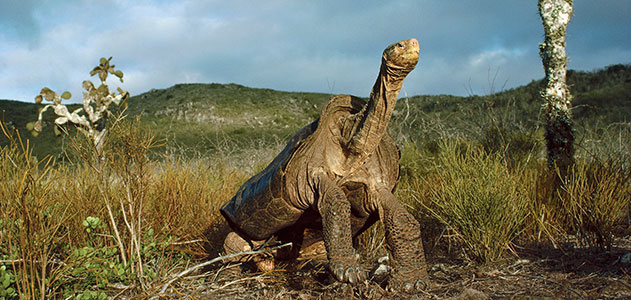
    Last but not least, are the Giant Tortoises. They are easily one of the most famous animals that lives on the islands. They eat mainly plants, including cactus pads, fruits and grasses. There are two species, the domed carpace and the saddle-back crapace. The domed Carpaces live on the more humid islands and are larger in size. The Saddle-back carpace live on the drier islands. Fun fact: Both species are able to live up to a year without food or water. 

    (mountiansoftravelphotos.com) Domed Tortoise


    (Smithsonianmag.com) Saddle-back Tortoise


    And that's it! And as today is March 17, Happy St. Patties day everyone!

    ~Sam